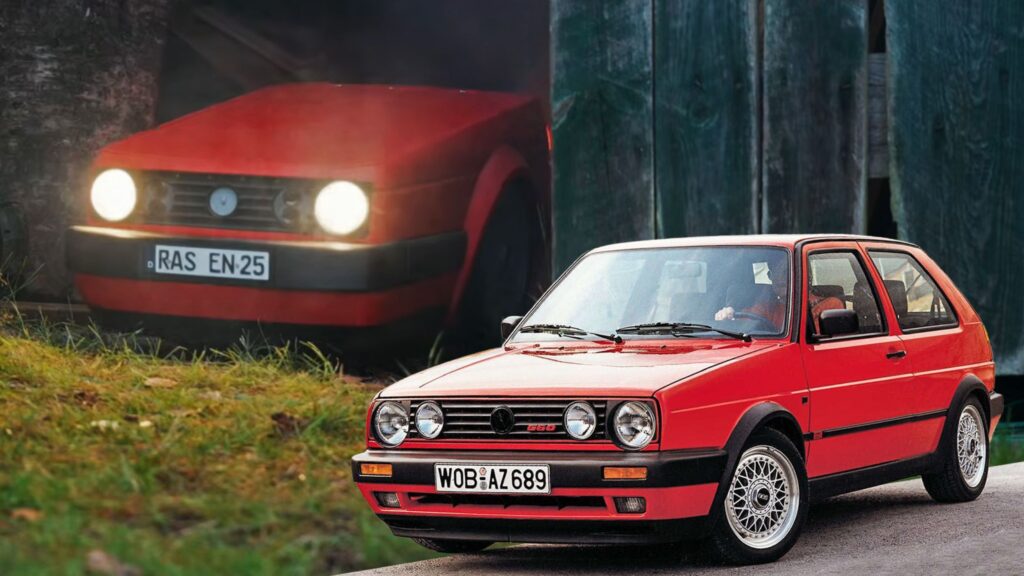



The Golf GTI didn’t just join the hot hatch segment, it invented it. Half a century on, plenty of people assumed emissions rules and electrification would finish the format off. They were wrong. The category is as crowded and hotly contested as it has ever been
For most of its existence, the Golf GTI was often viewed as the benchmark hot hatch. Quick enough, civilized enough, practical enough, and built well enough to humble cars costing far more. However, as even sportier rivals started to hit the market, including the Hyundai i30 N, the fourth-generation Renault Megane RS, and the current Honda Civic Type R, the GTI started to feel a little sedated, even in Mk8 guise.
Read: This Limited Edition GTI Beats The Clubsport And Golf R In Surprising Ways
Things have changed. The GTI received a midlife facelift last year and has the potential to catapult the flagship front-wheel-drive Golf back into serious hot-hatch territory. As we recently discovered, it does just that.
QUICK FACTS



Photos Brad Anderson/Carscoops
VW started with the engine. The EA888 2.0-liter turbocharged four-cylinder remains, but rather than delivering 180 kW (241 hp) and 370 Nm (273 lb-ft), it’s been uprated to 195 kW (262 hp), while torque remains the same. Even though it fails to reach the heights of the i30 N with its 206 kW (276 hp) and 392 Nm (289 lb-ft), or the Civic Type R with its 235 kW (315 hp) and 420 Nm (310 lb-ft), it’s more than quick enough.
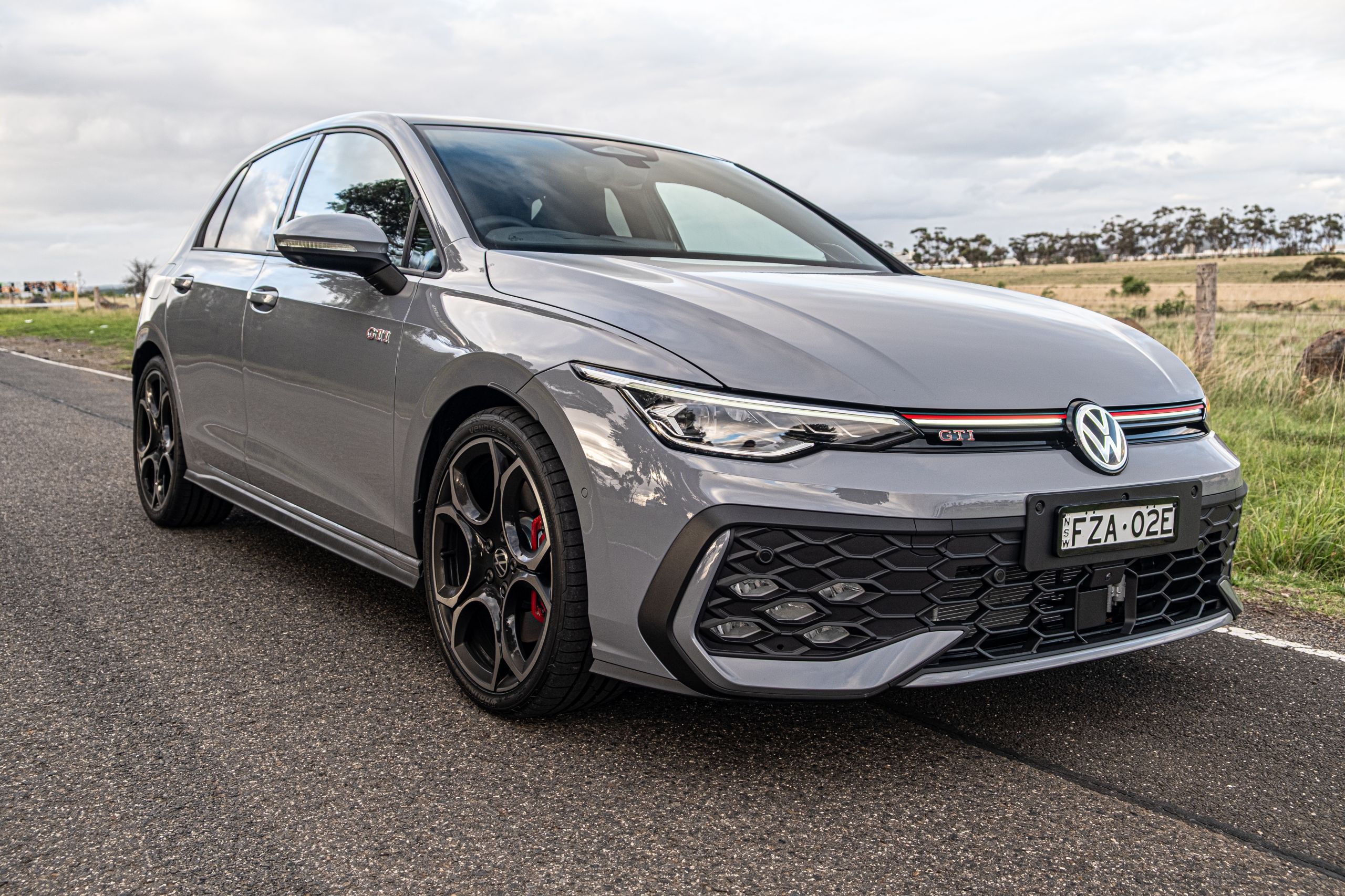
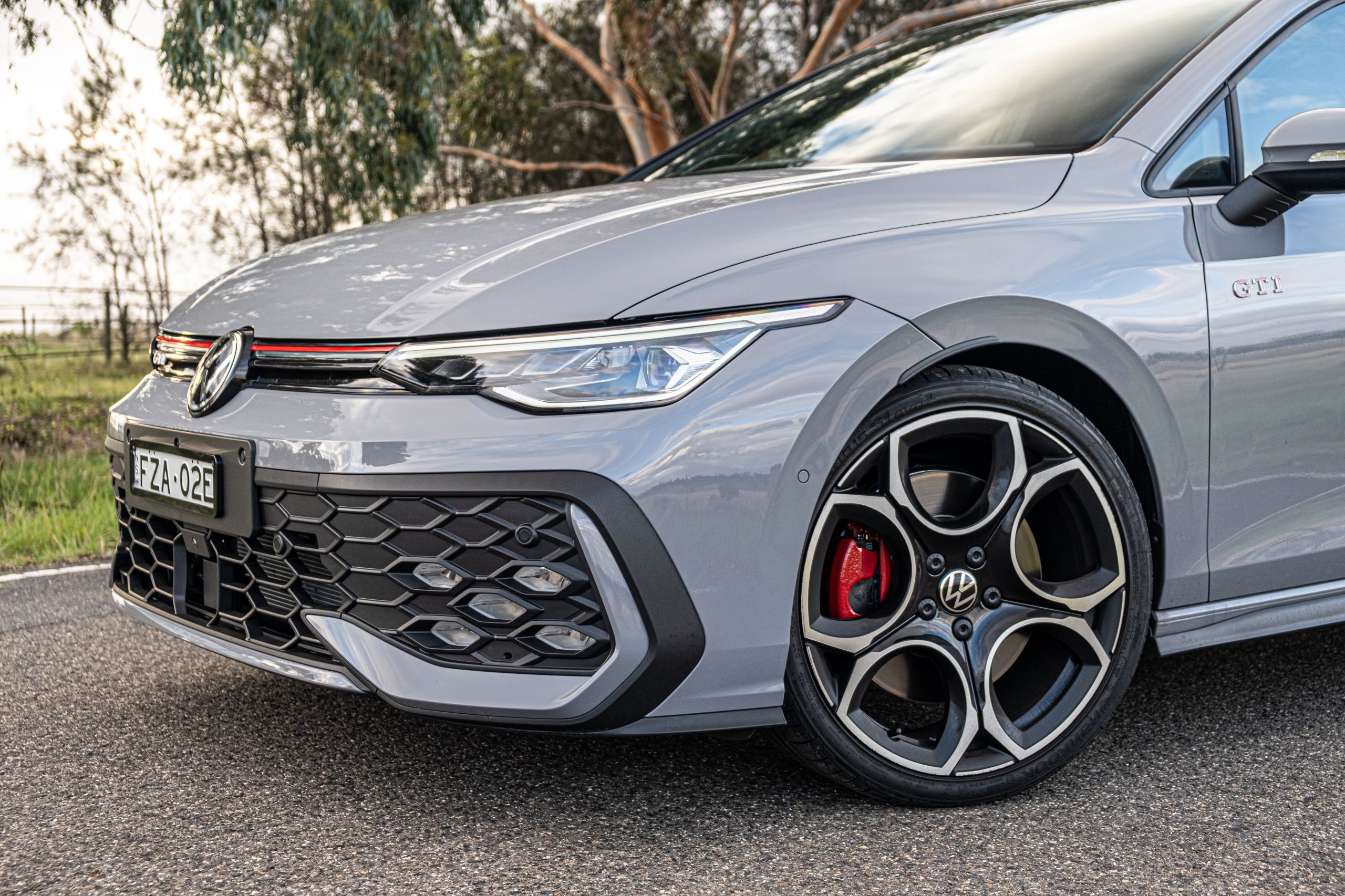
In addition to an uprated engine, the Mk8.5 Golf GTI has several chassis tweaks aimed at making it more dynamic. Updates include the same subframe as the TCR race car and adjustments to the Dynamic Chassis Control Pro system, offering 15 stages of damping adjustment. Throw in some visual tweaks, and you have a very spicy package indeed.
Sadly, the six-speed manual has been dropped, meaning a seven-speed dual-clutch remains the only option. As always, drive is sent exclusively through the front wheels. In Australia, prices start at AU$58,990 ($42,200) before on-road costs, while in the US, prices start at $34,590.
A Familiar, But Simple, Cabin


Photos Brad Anderson/Carscoops
The cabin of the Mk8.5 Golf GTI is similar to the pre-facelift model, but some tweaks have been made. It’s not the most eye-catching place to sit, but it gets all of the important things right.
First is the technology. A larger 12.9-inch infotainment display has been added, retaining wireless Apple CarPlay and Android Auto and sporting the brand’s latest software. The familiar touch-sensitive temperature and volume controls remain, and while they’re easy to get used to, I’d still prefer proper buttons.
Review: We Drove The 2025 VW Tiguan And It’s Not What You Expect
The seats provide plenty of comfort, while also holding you in tightly enough during sporty driving. With that being said, I think the bolstering could be beefed up, and it’s a shame that the standard seats are manually adjustable. Fancier, leather-appointed seats with heated, cooled, and electric adjustment functions are available, but only as part of the AU$3,900 ($2,800) Vienna Leather Package. This option also includes a head-up display and a 12-speaker Harman Kardon audio system.
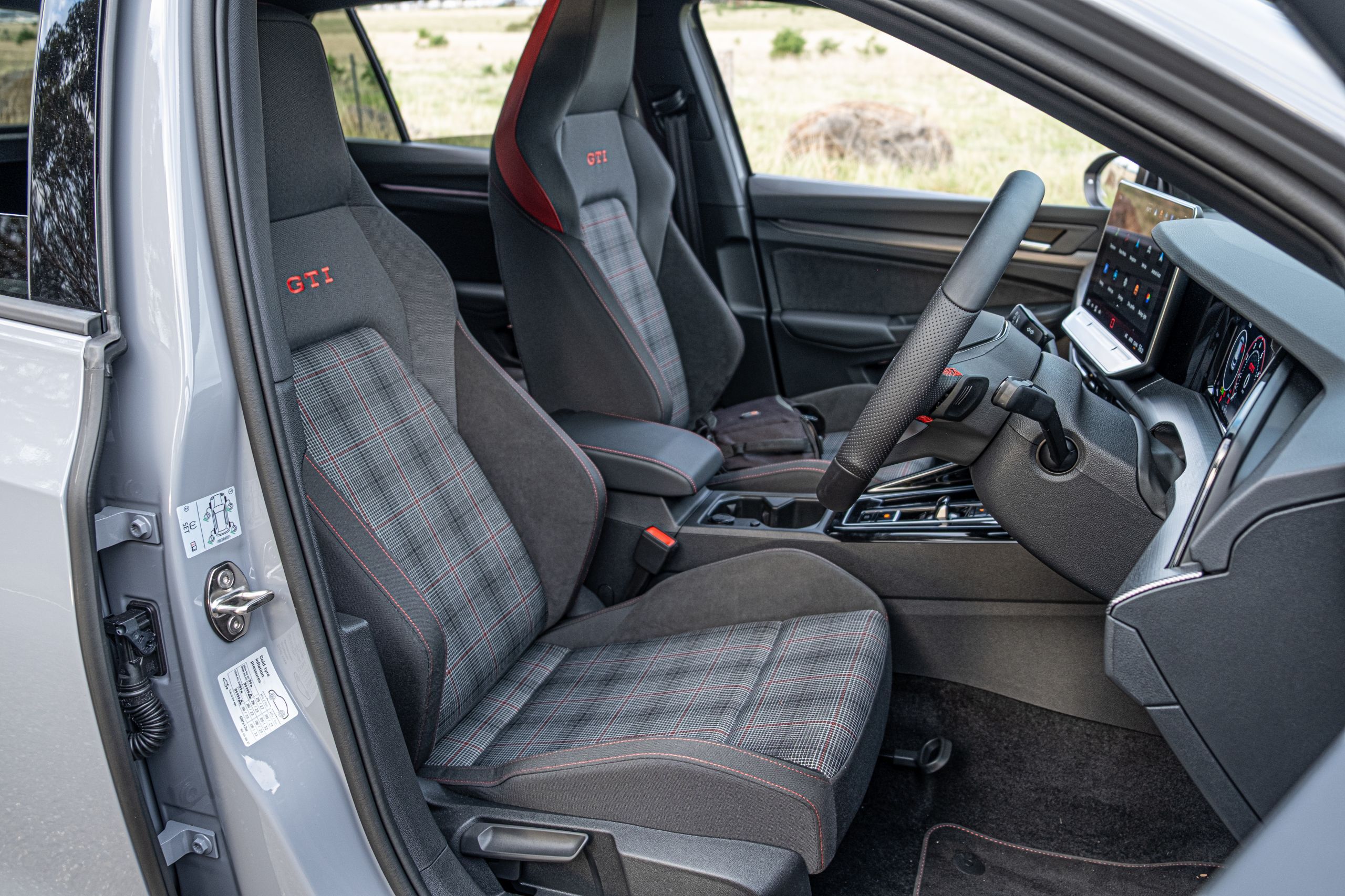
The fit and finish are right in line with what you’d expect from a hatchback at this price point. As for the rear, it offers enough space for taller adults and temperature adjustments. The tartan pattern on the front seats also extends to the second row, a welcome touch.
An updated steering wheel has also been included. It ditches the horrible touch-sensitive capacitive buttons of before, and instead uses physical buttons, which are much nicer to use.
A Hatch That’s Actually Hot


Photos Brad Anderson/Carscoops
As we’ve come to expect from the Golf GTI, it feels at home on the daily commute and is comfortable enough to fool you into thinking you’re driving a regular Golf. But it’s when the new car is pushed through turns that it really comes alive in a way that the pre-facelift model didn’t.
The added grunt has an immediate impact on how the updated GTI feels off the line. VW says it will hit 100 km/h (62 mph) in 5.9 seconds, and while we weren’t quite able to match that, we did record multiple 6.0-second sprints. Engaging launch control is exceptionally easy, and even with the traction control turned off, the systems reign in even the slightest hint of wheelspin when getting off the line. By comparison, the Mk7.5 Golf GTI TCR we tested several years ago turned into a burnout machine when using launch control.
Rolling acceleration is also strong. In our testing, the GTI can run from 60 – 120 km/h (37 – 75 mph) in 4.5-4.6 seconds, and while that’s a hair slower than the 4.3-seconds required by the i30 N and Civic Type R, it is a couple of tenths quicker than we managed in the more powerful Toyota GR Corolla with the slow-shifting eight-speed auto.
Read: VW’s Fastest Ever Golf GTI Is Still Slower Than A Civic Type R On The ‘Ring
No doubt playing an important role in the car’s acceleration is the seven-speed dual-clutch. VW’s DSG has long been one of the better dual-clutch systems on the market, and in the latest GTI, it provides incredibly quick shifts, both when changing up and when changing down. Low-speed bucking has also been mostly ironed out, and even changing down into 1st gear at high rpm is smooth.
The soundtrack has also been improved. Thanks to some software tuning, the Golf GTI sounds like a proper hot hatch should in the sportier driving modes, delivering plenty of pops and cracks from the exhaust. It’s not quite the rifle-like soundtrack of the i30 N or Megane RS, but it’s certainly more evocative than the Honda and Toyota.


Photos Brad Anderson/Carscoops
But, as always, it’s in the corners where the GTI shines. Clad in 19-inch Bridgestone Potenza S005 tires, understeer is nothing but a distant memory of yesteryear. The new GTI delivers immense front-end grip, offers excellent feedback on its limits, and gives drivers the confidence to push it harder and harder.
The limited-slip differential, of course, helps with handling, ensuring the front wheels hook into the pavement during turns. The only way to really upset the car is to turn off the traction and stability control and give it a bootful midway through a corner, which will cause the inside front tire to keep spinning up.
I was also surprised at how playful the car is. Tip it into a corner and let off the throttle, and it’s possible to invoke a little bit of lift-off oversteer, which can be easily controlled with the accelerator. It provides the dynamism the Golf GTI has been missing in recent years.
The adjustable suspension is also better than ever. As mentioned, it offers 15 levels of adjustment from soft to firm, but even in the firmest setting, it remains completely usable on the street. The GTI also offers more configurability than the Civic Type R and Toyota’s GR models, with options to adjust steering feel, engine responsiveness, exhaust note, and interior soundtrack.
Prior to the Mk8.5 model launching, the Golf GTI was shipped standard with a six-speed manual. However, due to Euro 7 emissions regulations and limited demand for the stick-shift, it was ditched in favor of the seven-speed dual-clutch. This decision will somewhat limit the appeal of the GTI among the most enthusiastic drivers, particularly given that some of the competition are offered with automatic and manual gearbox options.
Verdict


Photos Brad Anderson/Carscoops
Does the Mk8.5 VW Golf GTI feel like a monumental leap over the Mk8 that it replaced? No, it doesn’t. However, it doesn’t need to be. The Mk8 Golf GTI was already a very solid proposition and did most things right, especially when it comes to creature comforts, practicality, and usability.
But the old model lacked some of its old fire and had started to feel like the tame, safe option in the crowded hot hatch segment. Things have changed with this facelifted model. VW has been able to retain the calm demeanor that has always made the GTI great, while adding the pizazz it was missing.
Once again, the Golf GTI can be considered as a viable choice for driving purists who want something that can handle the everyday grind, and give some much more expensive sports cars a run for their money up a mountain road.