- Mazda introduces the 2026 BT-50 lineup in Australia.
- Flagship Thunder returns with a bull bar and extra LEDs.
- New Boss trim joins the range with black exterior accents.
The Mazda BT-50 has long lived in the shadow of Australia’s pickup heavyweights, namely the Ford Ranger and Toyota Hilux. For 2026, Mazda is looking to close that gap by expanding the lineup with two new variants, including the return of the adventure-oriented BT-50 Thunder and the new value-driven Boss trim with black accents.
The current generation of the BT-50 was introduced in 2020, sharing its bones with the Isuzu D-Max. Four years later the midsize pickup received a mid-cycle refresh, arriving in October 2024 with updated styling and revised in-car tech. That update also paved the way for a new entry-level engine, a 2.2-liter turbodiesel that finally reached Australian showrooms in September 2025.
More: Bare-Bones Mazda BT-50 Grows Stronger And More Capable
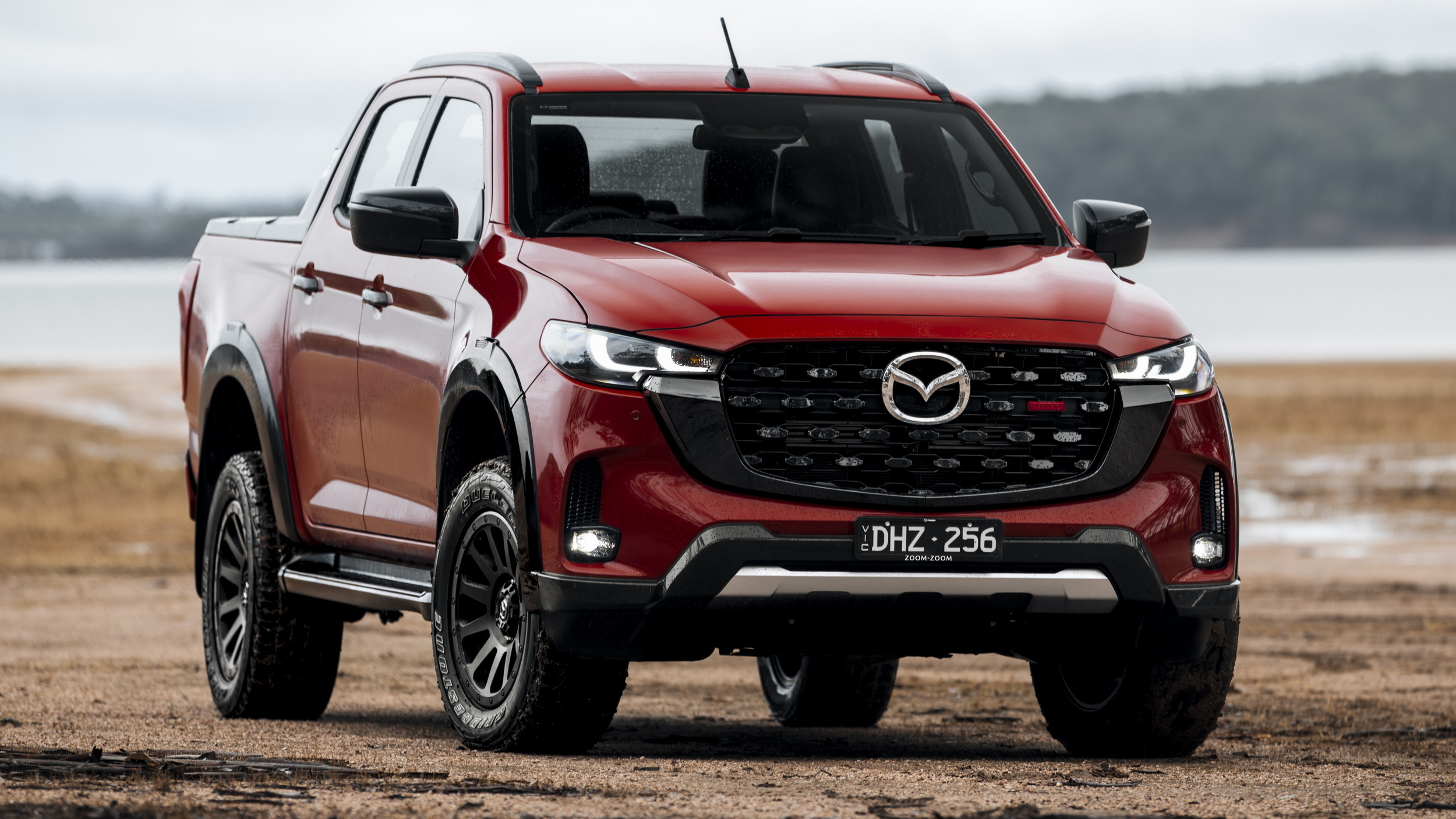
For 2026, Mazda brings the BT-50 Thunder back as the flagship of the facelifted lineup. Based on the GT trim, the Thunder stands out with a single-hoop steel bull bar that integrates Lightforce Beast LED driving lights. It also adds a tall steel sports bar, a manual roller tonneau cover, and black decals featuring Thunder lettering.
2026 Mazda BT-50 Thunder



Unfortunately, the 2026 BT-50 Thunder doesn’t get the flared wheel arches of its predecessor. They have not disappeared entirely, though. Buyers can still add them through Mazda Australia’s accessory catalog. The options list runs much deeper for those building a more trail-ready truck, including a larger triple-hoop bull bar, 18-inch alloy wheels, a snorkel, an LED lightbar, a roof rack, and several rear bed setups.
More: New Nissan Navara Bets On Mitsubishi To Fight The Hilux And Ranger
Unlike the Ford Ranger Raptor, Nissan Navara Pro-4X Warrior, and Isuzu D-Max Blade, which arrive with dedicated suspension upgrades, the BT-50 Thunder sticks with the standard hardware underneath. That places it closer in spirit to softer off-road variants such as the Toyota Hilux Rugged X, Mitsubishi Triton GSR, and Kia Tasman X-Pro. Buyers who want something tougher can still order the heavy-duty BP-51 or Nitrocharger suspension packages, offered across most trims.
What About The Boss?
The new BT-50 Boss takes a different approach. It builds on the dual-cab 4×4 XT grade and leans on cosmetic tweaks rather than off-road hardware. Gloss black finishes appear on the door handles, mirror caps, and grille, joined by a black steel sports bar, a standard tub liner, and side steps.
2026 Mazda BT-50 Boss


Diesel Power
Both the BT-50 Thunder and the Boss come exclusively with Mazda’s range-topping 3.0-liter turbodiesel, producing 187 hp (140 kW / 190 PS) and 450 Nm (332 lb-ft) of torque. The engine is paired with a six-speed automatic transmission that sends power to all four wheels.
More: The EV Truck Wave Is Growing But Mazda Is Steering The Other Way
Lower trims are available with a smaller 2.2-liter turbodiesel delivering 161 hp (120 kW / 163 PS) and 400 Nm (295 lb-ft) of torque. This unit is matched to an eight-speed automatic and can drive either the rear wheels or all four, depending on the configuration.
Unlike some competitors, the BT-50 lineup does not offer electrified powertrains. Mazda Australia’s managing director recently indicated the company still sees diesel playing a long-term role.
Accessories


Pricing
The 2026 Mazda BT-50 is now open for orders in Australia, with entry-level pricing set at AU$ 38,400 (US$ 27,100). That gets you the basic single-cab chassis XS, powered by the 2.2-liter diesel and driving the rear wheels.
More: Ford Turns The Ranger Super Duty Into A $65K Premium Workhorse
At the top of the price list sits the BT-50 Thunder. In dual-cab pickup form with the 3.0-liter diesel and standard 4×4, it comes in at AU$ 78,400 (US$ 55,300). That places it AU$ 4,910 (US$ 3,500) above the former range-topping SP, and AU$ 1,486 (US$ 1,050) higher than the rival Toyota Hilux Rugged X.
The newly introduced Boss lands in the middle of the range at AU$ 60,220 (US$ 42,500), which is AU$ 2,500 (US$ 1,800) more than the XT trim it builds on.